
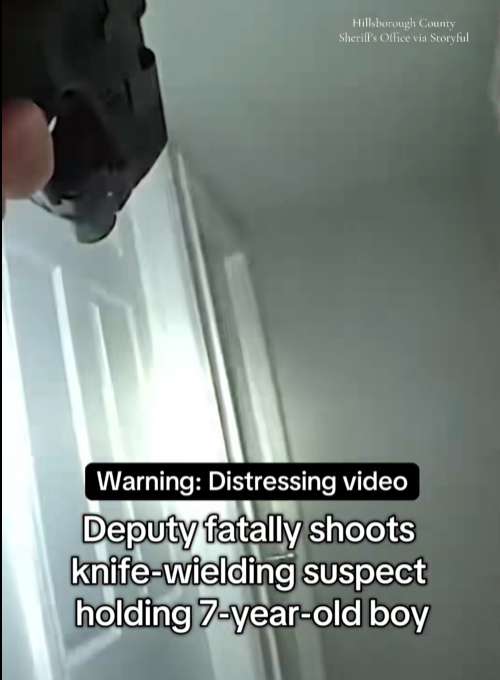
The bodycam footage begins with a jolt — an officer rushing up a narrow hallway, weapon drawn, breaths quick and controlled. The walls echo with tense voices as deputies coordinate their approach. Moments earlier, dispatch had received a frantic call claiming a 7-year-old boy was being held inside the home by an adult in a state of crisis.
No graphic injuries appear in the footage. No violent acts are shown. What viewers witness is the overwhelming intensity of a high-stakes rescue unfolding in real time.
As the deputy turns the corner, the hallway narrows. The flashlight beam sweeps across white walls, bouncing off doorframes and creating sharp shadows. Officers whisper commands to each other, every movement calculated. You can practically feel the adrenaline pulsing through the screen.
Behind a closed door, a child’s faint cries can be heard. The sound stops the team in their tracks. One deputy raises a hand, signaling silence. Another presses his ear to the door, listening for any movement inside.
Then a muffled voice erupts — panicked, unstable, and incoherent.
The person inside isn’t cooperating. They seem overwhelmed, confused, and emotionally volatile. Officers don’t know whether they’re armed, but the urgency in their tone makes clear that hesitation could put the child at risk.
The lead deputy calls out gently, “We just want to help. Let the boy walk into the hallway. Nobody wants this to get worse.”
A tense silence follows.
Inside the room, something crashes. The child screams again. Officers snap into motion.
With speed that looks effortless but requires years of training, deputies swing the door open and flood the room with commands. Their tone shifts from negotiating to protective, their attention fixed on the boy.
Within seconds, a deputy spots him — trembling, crying, and clutching himself near the corner. The adult who had been with him darts backward, startled by the sudden entry. It’s clear from their erratic movements that they’re experiencing a severe emotional crisis rather than acting with clear intent.
One deputy steps between the child and the adult, shielding him as two others take control of the situation without using excessive force. The adult collapses to the floor, overwhelmed and disoriented, while deputies quickly secure them to prevent any further risk.
The boy is lifted into the arms of a waiting officer and carried down the hallway, where paramedics and family members anxiously await. His cries soften once he’s in safe hands, and the relief on the officer’s face is unmistakable.
The video ends not with chaos, but with calm. Deputies escort the adult outside to receive medical and psychological evaluation, ensuring they get the help they need rather than escalating the situation unnecessarily.
Viewers online praised the deputies’ speed, teamwork, and restraint. Many commented that the clip shows the human side of law enforcement — officers trained not just to intervene, but to save lives in unpredictable, emotionally volatile situations.
Part 2 promises to show what led to the crisis call — and how the family is doing afterward.









Leave a Reply